
Emotion‑Aware Voice AI in 2026: How AVR Bridges Asterisk and Conversational AI
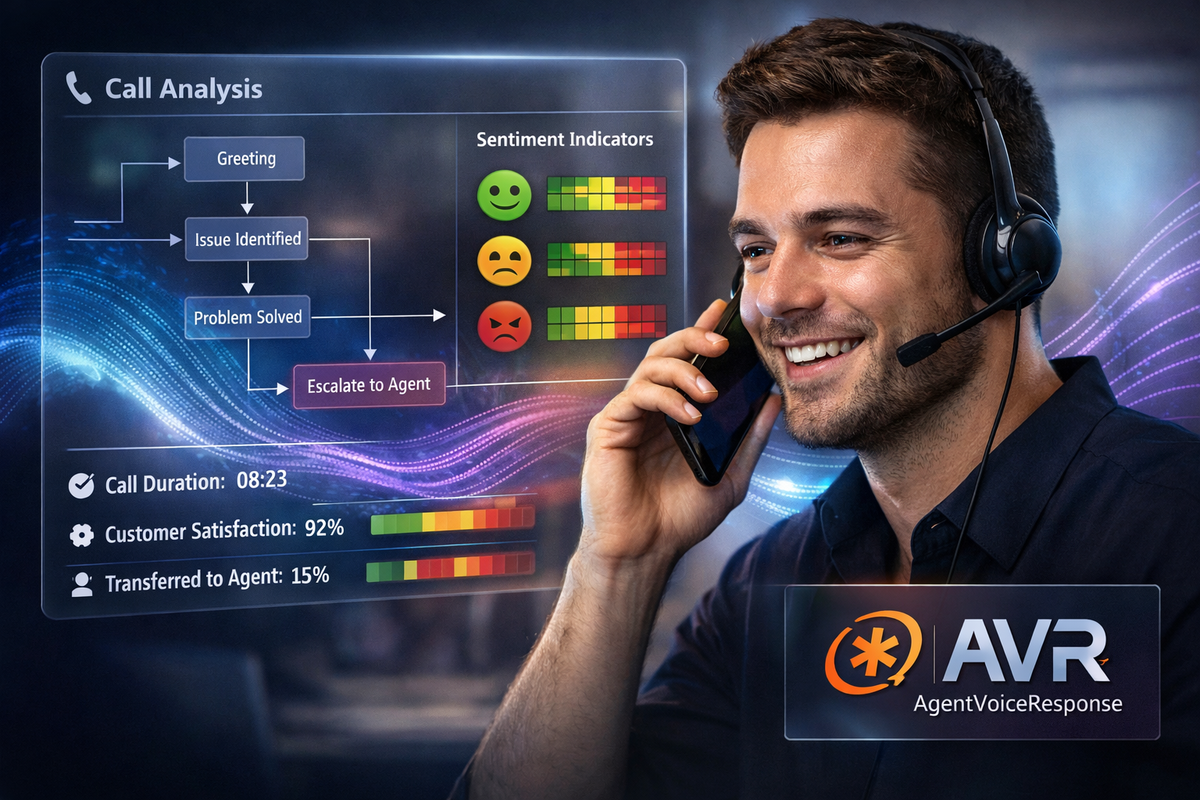
In 2026, voice AI is no longer just about answering questions—it’s about understanding tone, urgency, and emotion in real time. Emotion‑aware Voice AI systems can detect frustration, hesitation, or confusion during a live call and dynamically adapt their responses, making automated experiences feel less robotic and more respectful. Instead of forcing every caller through a fixed script, these agents can change paths, simplify language, or escalate to a human when sentiment deteriorates.
Contact‑center trends show that companies are moving from basic cost‑cutting automation to intelligent, context‑driven interactions where conversational AI sits at the core of the customer journey. Analysts predict that AI‑driven agents will handle a growing share of multi‑step, high‑volume transactions, while still keeping human teams available for sensitive or emotionally complex cases. At the same time, operational data indicates that well‑designed Voice AI can significantly reduce cost per contact and improve key metrics like First Call Resolution and Customer Satisfaction.
Emotion‑aware voice agents deepen this shift by treating every call as a stream of behavioural signals, not just a sequence of utterances. Modern platforms can already infer sentiment and urgency from tone, pace, and pauses, then trigger actions in real time: changing dialogue flows, notifying supervisors, or offering proactive gestures like faster service or discounts. This is where AgentVoiceResponse (AVR) comes into play: AVR’s architecture is built explicitly to integrate these layers of intelligence on top of your existing phone system.
On GitHub, the AVR project provides a full, Docker‑based infrastructure (avr‑infra) that orchestrates real‑time audio streams between Asterisk and your choice of ASR, LLM, and TTS providers. The flow is simple yet flexible: Asterisk sends audio to AVR Core via AudioSocket, AVR forwards the stream to a speech‑to‑text service (such as Google Cloud Speech‑to‑Text, Deepgram, or a local model), passes the text to an LLM (OpenAI, OpenRouter, local models, etc.), and then feeds the response to a TTS engine (ElevenLabs, Google, Coqui, Kokoro, etc.) whose audio is sent back into the same call through Asterisk. This modular STT → LLM → TTS pipeline can also be replaced with direct Speech‑to‑Speech (STS) setups using APIs like OpenAI Realtime, Gemini Live, or Deepgram for ultra‑low‑latency, end‑to‑end audio‑in/audio‑out conversations.
For Asterisk users, AVR offers first‑class integration through AudioSocket and the Asterisk Manager Interface (AMI). The avr‑infra repository is ready‑to‑run with a Docker‑compose example that starts AVR Core and local or cloud services, while leaving an “Asterisk stub” that demonstrates how to wire your own PBX (FreePBX, VitalPBX, Vicidial, or custom setups) into the pipeline. Additional modules like avr‑ami extend this with AMI‑based call control: AVR can ask the PBX to transfer a call, hang up, or originate outbound calls based on decisions made inside the LLM, all coordinated through a simple API layer.
This design means you can turn any Asterisk‑based infrastructure into an emotion‑ and context‑aware contact center without ripping out your existing numbers, carriers, or dialplans. Calls routed to a specific extension can be handed off to AVR, where the AI handles the conversation while leveraging sentiment‑aware models, external workflows, or business rules. AVR’s open repositories support a wide range of providers (Google, Deepgram, ElevenLabs, OpenRouter, n8n, Gemini, Ultra‑realtime services, etc.), so you can tailor the stack to your latency, cost, and data‑residency requirements.
If you are still treating phone calls as a black box with only basic metrics like duration and abandonment, 2026 is the right moment to partner voice AI with your Asterisk setup. Start with a limited pilot—monitor sentiment on one queue or run AVR for a single repeatable use case—and compare voice‑AI‑augmented calls against the traditional IVR or human‑agent flows. With AgentVoiceResponse, you get production‑ready, well‑documented GitHub components for Asterisk integration plus the flexibility to add emotion‑aware, process‑aware intelligence on top. The goal is not to replace human agents, but to give them richer insight and let them focus on high‑value, emotionally complex conversations that matter most.